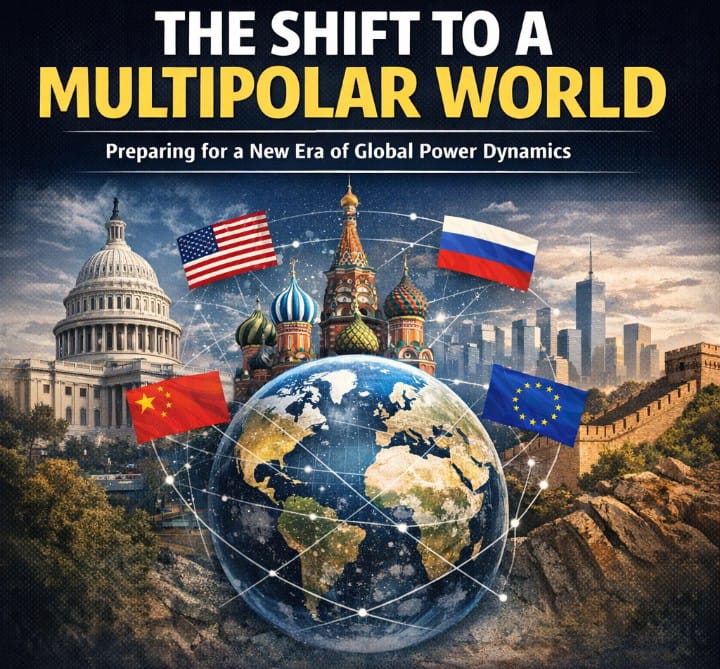
For more than three decades after the collapse of the Soviet Union in 1991, the world largely operated under a unipolar global order, dominated by the political, economic, and military influence of the United States. This period, often described by geopolitical analysts as the “American-led world order,” shaped international institutions, trade systems, and security alliances across the globe.
However, mounting geopolitical tensions, economic shifts, and rapid technological development are now pushing the international system toward a multipolar world order, where several major powers share influence rather than one dominant state.
The End of the Unipolar Moment
After the Cold War, the United States stood as the sole superpower. Institutions such as the NATO, the World Bank, and the International Monetary Fund operated largely within a framework shaped by Western leadership.
But over the last two decades, emerging powers such as China, Russia, and India have significantly expanded their geopolitical and economic influence.
China’s massive economic growth and global infrastructure initiatives, Russia’s assertive military and strategic posture, and India’s rising economic and technological capacity are all contributing to a redistribution of global power.
Strategic Alliances and New Power Blocs
Another major sign of the shifting global order is the rise of new geopolitical alliances. Organizations such as BRICS — which includes Brazil, Russia, India, China, and South Africa — are increasingly challenging Western-dominated financial and political systems.
Meanwhile, regional powers and alliances across Asia, the Middle East, and Africa are gaining greater autonomy in global decision-making. Energy politics, trade corridors, and digital infrastructure are becoming key arenas where influence is contested.
Experts argue that the world is gradually entering an era where power will be distributed among several influential centers, including the United States, China, the European Union, Russia, and India.
Technology, Economy, and Military Competition
The emerging multipolar order is not defined only by military strength. Economic resilience, technological innovation, and control over global supply chains are becoming equally critical.
Competition is intensifying in fields such as artificial intelligence, semiconductor production, cyber warfare, and space technology. Nations investing heavily in these sectors are positioning themselves for strategic dominance in the coming decades.
At the same time, global conflicts and tensions — including wars, sanctions, and trade disputes — are accelerating the transition away from a single dominant power structure.
What It Means for the Future
Analysts believe the transition toward a multipolar world could create both opportunities and instability. While a more balanced distribution of power may reduce unilateral dominance, it could also increase geopolitical competition and regional conflicts.
For developing nations, including countries across Asia and Africa, the changing global order presents a strategic moment. By strengthening economic capacity, technological innovation, and diplomatic partnerships, these nations can secure a stronger role in the emerging system.
Preparing for a Multipolar Era
Experts warn that the transformation is already underway. Nations that invest now in education, advanced technology, economic diversification, and strategic diplomacy are likely to gain influence in the coming decades.
As the global balance of power shifts, one thing is becoming increasingly clear:
the future international system will not be shaped by one power alone, but by multiple competing and cooperating centers of influence.
From Unipolar to Multipolar: The Global Power Shift Reshaping the Future
World | BanglaHour Research Desk
🕒 Published: 12 March 2026, Thu, 4:28 PM