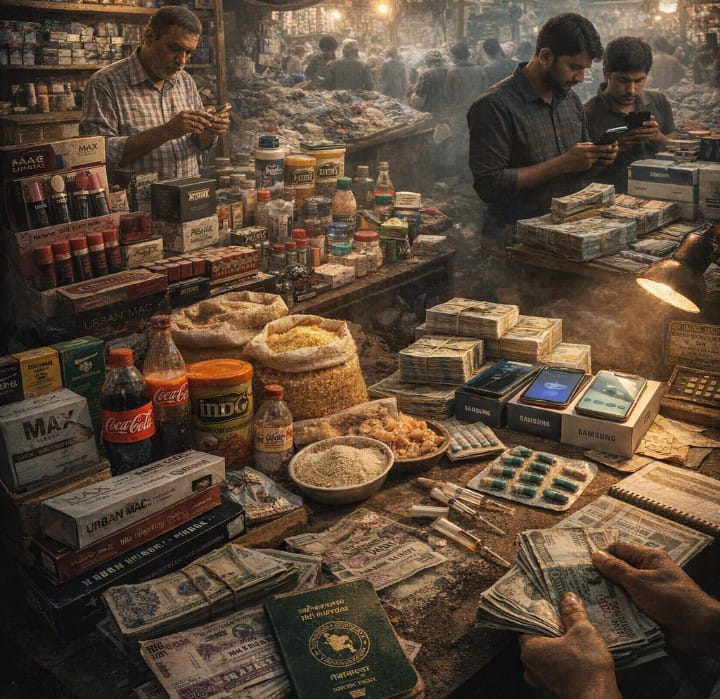
From cosmetics and food items to medicines and electronic goods, counterfeit products have quietly flooded markets across Bangladesh. While these items often appear identical to genuine brands, experts warn that the growing trade in fake goods is becoming a serious threat to public health, consumer rights, and the national economy.
An investigation into several local markets and online platforms reveals that counterfeit products are not only widespread but are also being sold openly in many places with little fear of enforcement.
A Multi-Billion Taka Shadow Market
According to industry insiders and consumer rights activists, the market for counterfeit goods in Bangladesh has expanded significantly over the last decade. Fake cosmetics, duplicate electronics, imitation clothing brands, and adulterated food products are now commonly found in both traditional markets and online stores.
Major urban markets, especially in large cities, often display products that closely resemble well-known international brands. In many cases, the packaging is designed to look almost identical to the original, making it difficult for ordinary consumers to distinguish between genuine and fake items.
Consumer protection experts say the counterfeit trade has evolved into a large underground economy worth billions of taka each year.
Health Risks and Consumer Deception
One of the most alarming aspects of counterfeit products is the potential risk to public health.
Fake cosmetics may contain harmful chemicals, counterfeit medicines may lack proper ingredients, and adulterated food items can pose serious health hazards. Experts warn that many of these products are produced in unregulated environments without proper quality control.
Investigators also found that many consumers unknowingly purchase fake products because they are offered at significantly lower prices than authentic brands.
However, the long-term cost of using such products can be far greater than the initial savings.
Online Platforms Expanding the Problem
The rapid growth of e-commerce and social media marketplaces has also contributed to the spread of counterfeit goods.
Many sellers promote branded products through online advertisements and social media pages, but the items delivered to customers are often fake or of extremely poor quality.
Consumer rights activists say weak monitoring of online marketplaces has made it easier for dishonest sellers to operate without accountability.
Law Enforcement and Regulatory Challenges
Authorities responsible for consumer protection, including the Directorate of National Consumer Rights Protection, occasionally conduct market raids and impose fines on businesses selling counterfeit goods.
Despite these efforts, experts say enforcement remains limited compared to the scale of the problem.
Smuggling networks, illegal manufacturing units, and complex distribution chains often make it difficult for authorities to identify the source of counterfeit products.
Economic Impact
Beyond consumer safety, counterfeit products also harm legitimate businesses and the national economy.
Local manufacturers and authorized distributors lose significant revenue when fake products dominate the market. This discourages investment and damages the reputation of brands operating legally within the country.
Economists warn that the unchecked growth of counterfeit trade can weaken market integrity and reduce consumer confidence.
What Can Be Done
Experts suggest several measures to combat the spread of fake products:
Stronger market monitoring and enforcement
Stricter penalties for counterfeit production and distribution
Improved regulation of online marketplaces
Public awareness campaigns to help consumers identify fake products
Consumer rights groups also emphasize the importance of buying products from trusted retailers and checking product authenticity whenever possible.
Conclusion
The spread of counterfeit goods in Bangladesh has become more than just a market issue—it is now a matter of public safety, economic stability, and consumer protection.
Unless stronger regulatory action and public awareness measures are implemented, experts warn that the counterfeit economy may continue to expand, putting millions of consumers at risk
Fake Products Flood Bangladesh Markets: An Investigative Report on a Growing Hidden Economy
Investigation | BanglaHour Research Desk
🕒 Published: 12 March 2026, Thu, 4:44 PM