
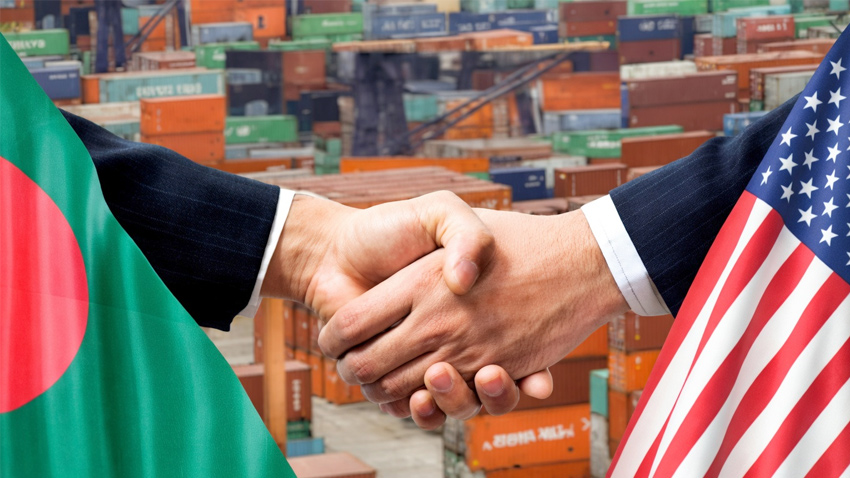
Although Bangladesh–U.S. relations have long been built on economic ties, trade, and development cooperation, political and strategic relations between the two countries have gained particular importance in recent years. Dhaka and Washington are engaged in regular discussions and exchanges on democracy, human rights, elections, security, the Rohingya crisis, the Indo-Pacific region, and regional geopolitics.
Following Bangladesh’s political changes in 2026 and the assumption of office by the new government, bilateral relations have entered a new phase. Prime Minister Tarique Rahman has expressed his determination to further strengthen ties with the United States. Washington has also indicated its willingness to work with Bangladesh’s elected government.
Diplomatic Relations Established in 1972
Following Bangladesh’s independence, the United States formally recognized Bangladesh on April 4, 1972. Formal diplomatic relations between the two countries were subsequently established on May 18, 1972.
Over more than five decades, bilateral relations have passed through various stages. While development cooperation and humanitarian assistance were initially central to the relationship, trade, investment, security, counterterrorism cooperation, climate change, and regional security later became important areas of engagement.
The U.S. Position on Democracy and Elections in Bangladesh
One of the most sensitive issues in Bangladesh–U.S. political relations is democracy and elections.
The United States publicly expressed concerns over Bangladesh’s 2024 national election. At the time, the U.S. Department of State stated that the election was not free and fair and that not all political parties participated. Washington also expressed concerns about peaceful assembly, freedom of expression, human rights, and political violence.
However, the situation changed following the political developments of 2026. An observer delegation from the International Republican Institute (IRI) monitored the February 2026 election and described it as an important stage in Bangladesh’s democratic transition.
Relations with the New Government
Following the 2026 election, Tarique Rahman assumed office as Prime Minister. Subsequently, official-level interest emerged in further advancing relations between Dhaka and Washington.
On July 4, 2026, on the occasion of U.S. Independence Day, Prime Minister Tarique Rahman sent a letter to President Donald Trump pledging to deepen bilateral relations. He identified trade, energy, investment, education, defense, and people-to-people contacts as important areas for future cooperation.
This indicates that Bangladesh’s new government is interested in viewing its relationship with the United States not merely in commercial terms but also as a broader strategic partnership.
The U.S. Position: Working with Whichever Government Comes to Power
An important aspect of Washington’s diplomatic position ahead of Bangladesh’s 2026 election was that the United States would work with whichever government the people of Bangladesh elected.
This position suggested that Washington placed importance on state-to-state and institutional relations rather than on Bangladesh’s domestic political rivalries.
At the same time, the United States has continued to emphasize democratic institutions, the rule of law, human rights, and political participation in Bangladesh.
Security and Defense Cooperation
Security and defense cooperation constitute another important pillar of Bangladesh–U.S. political relations.
On August 4, 2026, Admiral Stephen Koehler, commander of the U.S. Pacific Fleet, met with Prime Minister Tarique Rahman. Discussions covered defense cooperation, regional security, humanitarian assistance, and disaster response.
Given Bangladesh’s geographical position along the Bay of Bengal and within the Indo-Pacific region, its importance to Washington in terms of maritime security and regional stability is increasing.
Geopolitical Realities Surrounding China
China has also become an important factor in Bangladesh–U.S. relations.
A Reuters report in February 2026 stated that the United States saw opportunities to expand defense cooperation with Bangladesh’s new government and was interested in offering U.S. and allied defense equipment as alternatives to Chinese military equipment.
However, Bangladesh has historically sought to maintain balanced relations with different global powers. Dhaka aims to advance its economic and strategic ties with the United States, China, India, Japan, and other countries simultaneously.
The U.S. Role in the Rohingya Crisis
The Rohingya crisis is one of the most significant humanitarian and political issues in Bangladesh–U.S. relations.
More than one million Rohingya refugees are living in Bangladesh. The United States has long been one of the largest donors of humanitarian assistance to the Rohingya. In 2026, U.S. representatives also highlighted the need to increase international cooperation to support Rohingya refugees sheltered in Bangladesh.
Renewed violence in Myanmar’s Rakhine State and developments along the border are creating both security and humanitarian risks for Bangladesh. In recent months, renewed fighting in Rakhine has also led to reports of people fleeing into Bangladesh.
The U.S. role in building international pressure for the safe, voluntary, and dignified repatriation of Rohingya refugees remains important to Bangladesh.
Trade Has Become an Important Part of Political Relations
Economic relations are closely linked to political ties. On February 9, 2026, Bangladesh and the United States reached an agreement on a Reciprocal Trade Agreement.
Under the agreement, Bangladesh committed to providing greater market access for U.S. industrial and agricultural products. In return, the United States set a reciprocal tariff rate of 19 percent on Bangladeshi goods and announced arrangements for a zero-percent rate on certain specified products.
The agreement also covers labor rights, environmental protection, anti-corruption measures, intellectual property, and trade facilitation.
As a result, economic security and commercial interests have become more closely integrated into political discussions between the two countries.
Human Rights and the Rule of Law
The human rights situation in Bangladesh remains an area of interest for the United States and other Western countries.
U.S. policy has long emphasized democracy, the rule of law, human rights, freedom of expression, and labor rights. Following Bangladesh’s political changes, assessments of the situation in these areas have also evolved.
Human Rights Watch’s 2026 report highlighted various concerns in Bangladesh, including political detentions, law and order, the safety of minorities, and the situation of Rohingya refugees.
These issues are likely to remain important in future political discussions between Dhaka and Washington.
Bangladesh’s Importance to the Indo-Pacific Strategy
Bangladesh is an important country within the broader framework of the U.S. Indo-Pacific Strategy.
Its geopolitical and strategic significance stems from its location along the Bay of Bengal and its role in the Indian Ocean, maritime trade, regional connectivity, and supply chains.
U.S. policy has long emphasized the goal of establishing a free, open, peaceful, and prosperous Indo-Pacific region. Security and economic cooperation with Bangladesh forms part of this broader regional framework.
Challenges Ahead for Bilateral Relations
Bangladesh–U.S. relations face several important challenges, including:
- Strengthening democratic institutions.
- Ensuring human rights and the rule of law.
- Improving labor rights and working conditions.
- Finding a long-term solution to the Rohingya crisis.
- Maintaining a balance on trade and tariff issues.
- Preserving balanced relations with China and India.
- Expanding security cooperation in the Bay of Bengal and the Indo-Pacific.
- Increasing U.S. investment and technology cooperation in Bangladesh.
Where Are Relations Headed?
Current developments suggest that Bangladesh–U.S. relations are increasingly evolving into a multidimensional political and strategic partnership.
For Dhaka, the United States is important, particularly in terms of export markets, investment, technology, security, and international diplomacy. For Washington, Bangladesh matters because of its position along the Bay of Bengal, its role in the Indo-Pacific, regional stability, trade, and the Rohingya crisis.
However, the future of bilateral relations will not depend solely on economic agreements. Democracy, human rights, regional security, the Rohingya crisis, and Bangladesh’s ability to maintain balanced relations with major powers, including the United States, China, and India, will also play important roles.
Conclusion
Bangladesh–U.S. relations have entered a new reality after more than five decades of diplomatic engagement. Following the political changes of 2026, relations between Washington and Bangladesh’s new government are moving toward more pragmatic economic and security cooperation.
Prime Minister Tarique Rahman’s interest in deepening bilateral ties and Washington’s stated willingness to work with the new government point to fresh possibilities for the future of the relationship.
At the same time, democracy, human rights, labor rights, the Rohingya crisis, and regional geopolitics will remain important tests for bilateral relations. Consequently, the future of Dhaka–Washington ties will involve both cooperation and the balancing of mutual interests and policy positions.