
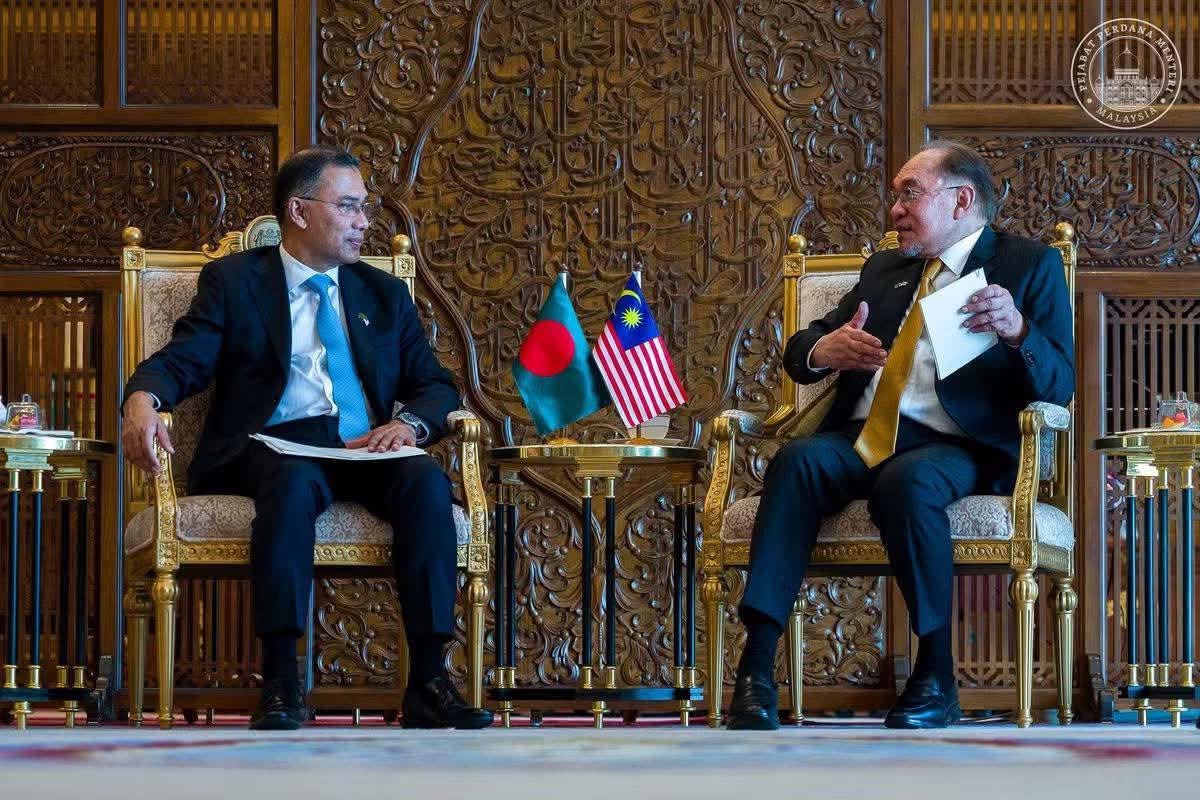
At the invitation of the Prime Minister of Malaysia, His Excellency Dato’ Seri Anwar Ibrahim, His Excellency Tarique Rahman, Prime Minister of the People’s Republic of Bangladesh, undertook an official visit to Malaysia on 22 June 2026.
2. This visit marked Prime Minister Tarique Rahman’s first official visit abroad and to Malaysia since assuming office on 17 February 2026. Since the establishment of diplomatic relations in 1972, Malaysia and Bangladesh have reached significant milestones in the longstanding partnership between the two countries, anchored in mutual respect, shared values, and common aspirations for regional peace and prosperity.
3. During the visit, Prime Minister Tarique Rahman was accorded an official welcoming ceremony at the Perdana Putra Complex, Putrajaya. The Leaders then held an official bilateral meeting to discuss Malaysia-Bangladesh relations and exchanged views on regional and international issues of mutual interest. Both Leaders expressed strong commitment to take the bilateral relations between Malaysia and Bangladesh to further new heights. Prime Minister Anwar Ibrahim also hosted an official luncheon in honour of Prime Minister Tarique Rahman. They witnessed the exchange of several bilateral documents aimed at further enhancing cooperation between the two countries.
4. Prime Minister Anwar Ibrahim congratulated His Excellency Tarique Rahman on his appointment as the Prime Minister of the People’s Republic of Bangladesh as this marks a new chapter for the Bangladesh people with hopes of peace, stability and progress.
Political Cooperation
5. The Leaders agreed that regular dialogue and exchanges including high-level visits, have strengthened coordination across various areas of bilateral cooperation, including labour cooperation. They highlighted the importance of sustaining engagement on bilateral and multilateral issues of mutual interest.
6. The Leaders acknowledged the importance of regular dialogue through existing bilateral institutional mechanisms and in this regard agreed to resume the long-pending Joint Commission Meeting (JCM) as well as the Bilateral Consultations (BC) at the earliest opportunity.
Trade and Investment Cooperation
7. Both Leaders acknowledged the significance of bilateral trade and investment relations, noting that Bangladesh remains Malaysia's second-largest trading partner in South Asia. The Leaders expressed their commitment to further strengthening economic cooperation and facilitating two-way trade and investment.
8. The Leaders welcomed the progress made towards the commencement of negotiations on the Malaysia-Bangladesh Free Trade Agreement (MBFTA). Both sides expressed their commitment to advancing the negotiations with a view to concluding the Agreement in 2027 for a mutually beneficial, comprehensive and forward-looking agreement that reflects current global trading practices.
9. The two Prime Ministers welcomed the progress made in the establishment of the Malaysia-Bangladesh Joint Business Council (JBC), which will serve as the key bilateral institutional mechanism for structured dialogue and the exchange of ideas to facilitate active collaboration between the private sectors of the two countries, thereby expanding bilateral economic, trade and investment ties.
10. Stressing the importance of enhancing trade, investment and sustainable economic partnership, the Leaders encouraged greater collaboration across priority sectors including telecommunications, energy, infrastructure (e.g, roads, bridges, elevated expressways and digital public infrastructure), ports and logistics, halal industry, agro-processing, education and skills development, digital economy, semiconductor, smart manufacturing and other high-value across industries.
11. The Leaders further encouraged closer cooperation between relevant government agencies, investment promotion agencies, industry players and business communities of both countries through investment facilitation, technical cooperation, capacity building, technology transfer, talent development, business matching and strategic partnerships, aiming to foster industrial upgrading, strengthen regional and global value chain participation, and create mutually beneficial investment opportunities for both nations.
Halal Industry
12. The Leaders acknowledged the significant commercial potential of the global Islamic economy. Recognising Malaysia’s expertise and extensive experience in the development of the halal ecosystem, they agreed to strengthen bilateral cooperation in support of Bangladesh’s development in its halal sector.
13. They acknowledged the Exchange of Notes on Cooperation in the Field of Halal Ecosystem and welcomed ongoing collaboration between the Department of Islamic Development Malaysia (JAKIM) and the relevant regulatory authorities of Bangladesh. They reaffirmed their commitment to further enhance cooperation in areas including halal certification the development of regulatory frameworks, capacity building and training of professionals’ research and innovation, as well as institutional strengthening.
Digital Economy, AI and Semiconductor
14. Both Leaders recognized the growing importance of digital transformation as a driver of economic growth and competitiveness and agreed to strengthen cooperation in Artificial Intelligence (AI), the digital economy, fintech, digital governance, cybersecurity, and other emerging technologies. In this regard, they welcomed enhanced collaboration and closer engagement among government agencies, research institutions, universities, and private-sector stakeholders of the two countries. The Leaders also agreed to promote capacity building and knowledge sharing, leveraging Malaysia’s expertise in digital development, and encouraged greater Malaysian investment in Bangladesh’s digital economy, including in digital public infrastructure, technology parks, and special economic zones.
15. Recognizing Malaysia’s established global footprint in semiconductor packaging, testing, and outsourced semiconductor assembly and test (OSAT) services, the Leaders agreed to bridge this mature ecosystem with Bangladesh’s rapidly expanding IT and engineering sector. Bangladesh proposed a bilateral talent cooperation framework under which both countries would jointly develop and systematically upskill Bangladeshi engineering graduates through structured programs, including exchange of experts and sharing of best practices. Such cooperation can contribute to supply chain resilience and regional co-operation in the semiconductor industry.
Labour Cooperation
16. The Leaders recognised the importance of people-to-people connectivity and welcomed the contribution of Bangladeshi workers to the development of Malaysia. They further noted that the Bangladeshi expatriate community plays a part in fostering bilateral exchanges and shared economic activities between Malaysia and Bangladesh.
17. Malaysia acknowledged Bangladesh’s proposal regarding the recruitment of workers. In line with Malaysia’s current policy on foreign labour intake, both sides recognised that approvals for new foreign worker quotas are currently evaluated strictly on a case-by-case basis, contingent upon verified employer requirements and sectoral ceilings. For any such approved quotas, both nations reaffirmed their commitment to ensuring the recruitment process is transparent, fair, non-discriminatory, and competitive, utilising only credible and qualified recruitment agencies.
18. Both countries have agreed to convene the Joint Working Group (JWG) to ensure the continued, safe, and mutually beneficial migration of Bangladeshi workers to Malaysia. The meeting will focus on evaluating the existing Memorandum of Understanding (MoU) and laying the groundwork to draft a new, updated MoU that meets the current needs of both nations.
Education and Tourism Cooperation
19. Recognising the presence of around 11,000 Bangladeshi students in Malaysia, and their positive contribution to academic exchange and socio-economic linkages between Bangladesh and Malaysia, as well as the value they bring upon returning to Bangladesh, both Leaders agreed to strengthen cooperation in the field of education, including through University-to-University partnerships and joint research programs, focusing on technical and vocational education (TVET).
20. Both sides emphasised on expanding mutually recognised qualifications, joint degree programmes and flexible learning pathways. The Leaders also stressed on the importance of aligning academic programmes with labour market needs and priority sectors in both countries, with particular focus on graduate mobility and skills development.
21. Both Leaders expressed optimism in expanding tourism cooperation, particularly in light of Malaysia’s “Visit Malaysia 2026” (VM2026) and “Malaysia Year of Medical Tourism 2026” (MYMT2026) campaigns. Malaysia extended a warm welcome to Bangladeshi travellers, and the leaders agreed to enhance tourism promotion and cultural exchanges between the two countries.
Energy Cooperation
22. Both sides recognised the importance of strengthening cooperation in the energy sector as a key pillar of bilateral economic relations. Both sides emphasize the importance of fully leveraging the agreed MoU between the Government of Bangladesh and the Government of Malaysia on co-operation in the field of Liquefied Natural Gas (LNG) Supply, LNG Infrastructure, Petroleum Products, and its infrastructure for direct bilateral LNG discussion between PETRONAS and PetroBangla.
23. Bangladesh side invited Malaysian companies to invest in Bangladesh’s energy sector, including in exploration of oil and gas in the Bay of Bengal, extraction of untapped minerals like coal, limestone, including renewable energy transition. Both sides also encouraged cooperation between relevant national energy companies and private sector stakeholders. to promote long-term, mutually beneficial partnerships that contribute to energy security, sustainability, and economic development in both countries.
Defence and Security Cooperation
24. The Leaders commended the excellent, longstanding ties in defence cooperation, anchored by regular high-level military visits, personnel training programs, and goodwill naval port calls. Both Leaders committed to fully operationalizing the MoU on Defence Cooperation to broaden strategic collaboration in military science, technical expertise, and defence industry partnerships. They looked forward to the convening of the bilateral Joint Committee on Defence Cooperation (JCDC) to chart a structured defence roadmap.
25. Both Leaders underscored the importance of enhancing defence capacity and capability through courses and training programmes, including mutual seat allocations at their respective National Defence Colleges and Command and Staff Colleges. They further reaffirmed their commitment to supporting United Nations peacekeeping operations through joint tactical exercises, pre-deployment training collaboration, and the exchange of expertise and knowledge to address an increasingly complex global security environment.
26. Both Leaders reaffirmed their commitment to strengthening bilateral cooperation in preventing and combating terrorism and violent extremism in all its forms and manifestations through intelligence sharing, information exchange, capacity-building initiatives, training programmes, and the sharing of best practices.
Regional and Multilateral Cooperation
27. Both Leaders expressed concerns over the prolonged Rohingya crisis. Malaysia commended Bangladesh’s humanitarian endeavour in hosting the forcibly displaced Rohingyas and reaffirmed its solidarity with Bangladesh. Malaysia reiterated its commitment to support efforts aimed at achieving a lasting resolution of the crisis which lies in the safe, dignified, and sustainable repatriation of the displaced Rohingyas to Myanmar. Bangladesh expressed appreciation for Malaysia's continued support and principled advocacy on the Rohingya issue at the bilateral, regional, and international platforms, including within ASEAN, the Organisation of Islamic Cooperation (OIC), the United Nations, and other multilateral forums.
28. Prime Minister Tarique Rahman reiterated Bangladesh’s strong desire to formalize its engagement with ASEAN by pursuing ASEAN Sectoral Dialogue Partner status. Prime Minister Anwar Ibrahim welcomed Bangladesh’s interest and expressed Malaysia's readiness to constructively support Dhaka’s aspirations within the ASEAN framework.
29. The Malaysian side expressed its support for Bangladesh’s aspiration to join the Regional Comprehensive Economic Partnership (RCEP), recognizing its growing economic significance and strategic role in the region. Both Leaders noted that Bangladesh’s future participation would strengthen regional economic integration, trade, investment, and supply chains. The Bangladeshi side expressed its appreciation for Malaysia’s support and reaffirmed its commitment to undertaking the necessary measures towards accession to the Agreement.
30. The Leaders exchanged views on the situation in the Middle East and reiterated their support for a just and lasting peace for the Palestinian people and expressed support for continued dialogue and diplomatic efforts towards a durable and comprehensive peace in the region.
31. The leaders emphasised the importance of joint efforts in addressing traditional and non-traditional security challenges such as climate change, food security, human trafficking and transnational crime. Both Leaders emphasised the need to address these challenges in a holistic manner.
32. The two leaders also acknowledged the importance of coordinated actions within international organisations such as the United Nations (UN) and the Organisation of Islamic Cooperation (OIC). They also committed to jointly supporting initiatives to strengthen the world order, justice, and compliance with international law.
33. Prime Minister Tarique Rahman expressed deep appreciation and sincere gratitude to Prime Minister Anwar Ibrahim and the Government of Malaysia for the warm welcome and gracious hospitality extended to him and his delegation during the visit.